One Organisation, Multiple Merchants: Smarter Payment Architecture with OneKhusa
Learn how OneKhusa’s multi-merchant architecture helps one organisation manage payments separately across different branches while keeping everything under one organisational structure.
One Organisation, Multiple Merchants: Smarter Payment Architecture with OneKhusa
One organisation. Multiple merchant accounts. Clearer payment operations.
A business may operate as one organisation, but that does not mean every payment should pass through the same merchant account.
As organisations grow, different branches, departments, services, or products may need to manage payments independently. When everything is processed through one merchant account, reconciliation, reporting, access control, and integration management can become harder.
OneKhusa supports a multi-merchant architecture, allowing one organisation to operate multiple merchant accounts while keeping them connected under the same organisational structure.
One Organisation Does Not Mean One Merchant
The organisation represents the overall business or institution.
Merchant accounts can represent individual branches or other payment operations within that organisation.
For example, a school organisation operating in different regions can create separate merchant accounts for each regional branch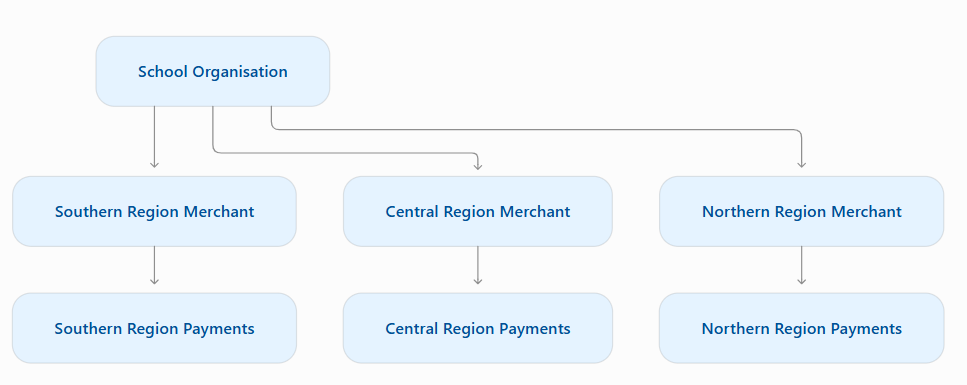
All three merchant accounts belong to the same organisation, but each one has a clear payment purpose.
This allows the payment structure to follow the way the organisation actually operates.
Why Multiple Merchant Accounts Matter
The main benefit is separation.
Different merchant accounts can help an organisation:
- Separate payment activity by branch.
- Make reconciliation easier.
- Identify where a transaction belongs.
- Manage integrations independently.
- Reduce unnecessary sharing of payment credentials.
- Keep payment configurations aligned with operational responsibilities.
Instead of sending every transaction into one large pool and separating it later, the organisation can identify the correct merchant account from the beginning.
A Simple Business Example
Consider a school organisation with branches in the Southern, Central, and Northern regions.
All branches belong to the same organisation, but management may still want each branch to manage and track its payments independently.
The organisation can create:
- Southern Region Merchant
- Central Region Merchant
- Northern Region Merchant
When a student makes a payment, the application can identify the student's branch and route the transaction to the correct merchant account.
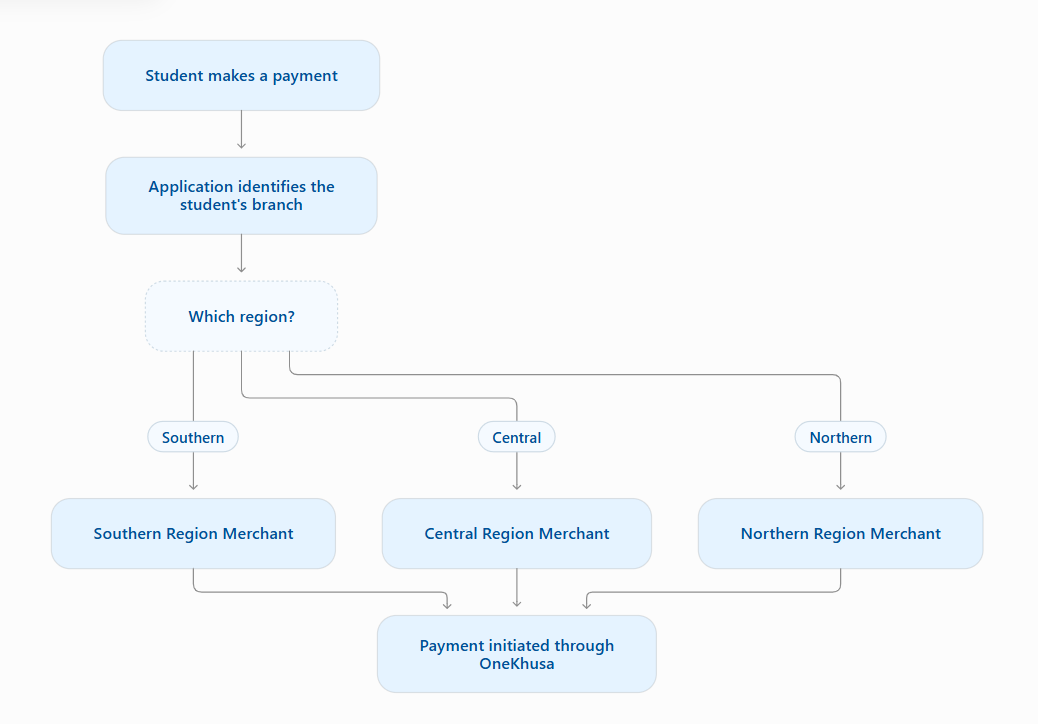
The transaction is associated with the correct branch before it is processed.
This gives the organisation a clearer view of payment activity while keeping all regional branches connected under the same organisation.
Design Around the Business
When building an integration, developers often begin by asking:
Which endpoint should I call?
In a multi-merchant setup, another question should come first:
Which merchant should own this transaction?
The answer should normally come from the application's business context.
If a student belongs to the Central Region branch, the application already has that information and can select the Central Region Merchant before initiating the payment.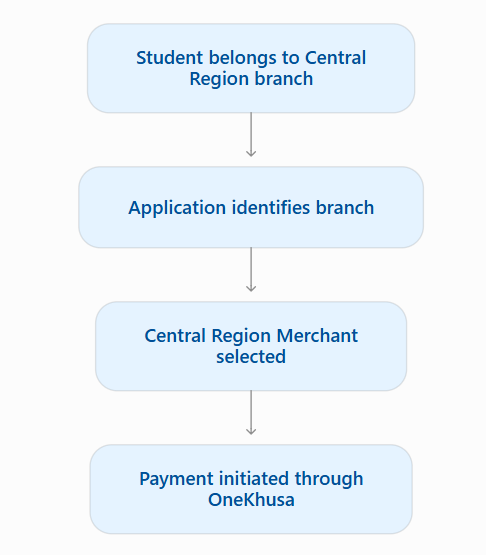
This keeps payment routing aligned with the organisation's real operational structure.
When Should You Create Another Merchant?
A separate merchant account is useful when part of the organisation genuinely needs its payment activity to be managed or identified independently.
Before creating another merchant, ask:
Does this branch or business unit need a separate payment identity?
If the answer is yes, creating another merchant may provide a cleaner architecture.
If there is no meaningful operational separation, the existing merchant account may already be sufficient.
The goal is not to create as many merchants as possible. The goal is to create merchant boundaries where real business boundaries exist.
The Key Principle
One organisation does not mean one merchant account. Create merchant boundaries where the business has real operational boundaries.
For a small organisation with one branch, one merchant account may be enough.
As the organisation expands into multiple regions or branches, multiple merchant accounts can provide clearer separation between payment operations while keeping everything connected to the same organisation.
One Organisation → Multiple Merchants → Clearer Payment Operations
For details on creating additional merchant accounts, refer to the OneKhusa Docs — Create Merchant documentation.
Garry Balala
Software Developer Advocate, OneKhusa

Enjoyed reading this? Share it now.



 (+265)994444455
 payments@khusa.africa